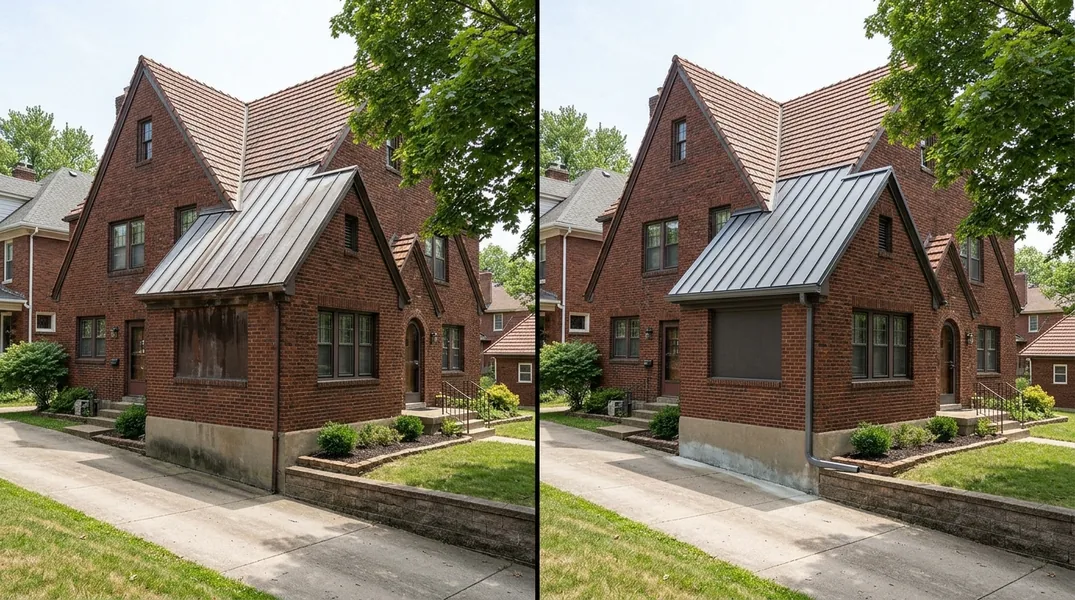
Understanding the Two Main Metal Roofing Systems
If you are considering a metal roof for your home, you have probably noticed that the market offers two very different systems: standing seam and corrugated (also called exposed fastener) metal roofing. Both are durable, attractive, and long lasting, but they work in fundamentally different ways. Understanding those differences is the key to choosing the right roof for your house, your budget, and your long term plans.
Standing Seam Metal Roofing uses large panels with raised seams that are fastened to the roof deck with hidden clips. No screws penetrate the surface of the panel, which means the roof has far fewer potential leak points. Corrugated metal roofing, by contrast, is an exposed fastener system: the panels are screwed directly through the metal into the structure, and each screw is sealed with a rubber washer. It is a simpler, older technology that remains popular because it is affordable and straightforward to install.
For homeowners in Cincinnati, the choice often comes down to budget versus longevity. Both systems can handle the region's freeze thaw cycles and summer storms, but they perform differently over decades. Below we break down the tradeoffs so you can make an informed decision.
Standing Seam Metal Roof Cincinnati: The Premium Choice
Standing seam is widely regarded as the gold standard in residential metal roofing. Because the fasteners are hidden, the panels can expand and contract freely with temperature changes without stressing the screw holes. That matters in Cincinnati, where roofs can swing from single digits in January to the high nineties in July. The concealed clip system absorbs that movement, which is why standing seam roofs routinely last 40 to 70 years with minimal maintenance.
The clean, vertical lines of standing seam also deliver strong curb appeal. Many homeowners in Montgomery and other historic or upscale neighborhoods choose standing seam because it looks refined and modern without being flashy. It is also an excellent platform for solar panels, since the raised seams allow mounting hardware to clamp on without penetrating the roof. The main drawback is upfront pricing: standing seam typically costs more per square foot than corrugated because the panels are more complex to form and install.
Exposed Fastener vs Standing Seam: Performance and Maintenance
The biggest practical difference between exposed fastener and standing seam comes down to maintenance. On a corrugated roof, every screw is a small penetration in the metal, and the sealing washer under each screw can dry out, shrink, or back out over time. In a climate with as much rain and temperature fluctuation as ours, those washers are the first thing to fail. Homeowners with corrugated roofs should plan to inspect and reseal screws every few years, and eventually some panels may need to be re-fastened.
Standing seam eliminates that chore almost entirely. With no exposed screws, there is nothing to reseal on the field of the roof, and annual maintenance is usually limited to clearing debris from valleys and gutters. That lower maintenance burden is a major reason why many homeowners who plan to stay in their house for 20 years or more choose standing seam. Corrugated still has its place, especially on barns, sheds, and budget conscious projects, but for a primary residence, the reduced upkeep of standing seam is hard to beat.
Metal Roof Installation Near Me: Which System Fits Your Home?
Choosing between the two systems is not just about money. It is about the pitch of your roof, its structure, and how long you intend to own the home. Standing seam performs best on roof pitches of 3:12 or steeper, and it requires a solid deck and proper underlayment. Corrugated panels can work on lower slopes with the right overlap, but they are more sensitive to installation quality. A professional Metal Roof Installation assessment will tell you which system your roof can support and what kind of sub-structure work may be needed.
If your existing roof is asphalt shingles, you may also be a candidate for a Metal Roof Over Shingles (Retrofit), which can save on tear off costs. Whether you are in Blue Ash or Norwood, the right answer depends on your home's age, framing, and ventilation. A reputable installer will walk you through both options honestly rather than pushing the more expensive system. If you are unsure which direction to go, request a free estimate and ask for a side by side comparison for your specific roof.
Metal Roof Replacement Cost in Cincinnati: What to Budget
Cost is usually the deciding factor for homeowners, and the gap between the two systems is real. Corrugated metal roofing is generally the more affordable option, often landing in the lower range per square foot because the materials are less expensive and the installation is faster. Standing seam sits at the higher end, reflecting the cost of concealed clips, longer panels, and more skilled labor. Exact numbers depend on roof size, pitch, complexity, and whether a tear off is required, so any honest contractor will want to see your roof before quoting a firm number.
It helps to think in terms of cost per year of service. A corrugated roof may cost less today but require periodic maintenance and a shorter replacement cycle, while a standing seam roof costs more upfront but can last decades with almost no upkeep. For many homeowners, the long term math favors standing seam. When you are ready to talk numbers, call Cincinnati Metal Roofing at (513) 650-6986 or visit our pricing page to see how we structure estimates. We are happy to compare both systems for your home and help you choose the roof that makes the most sense for your budget and your future.
Looking for a professional metal roofing contractor in Cincinnati? Cincinnati Metal Roofing responds fast for all your metal roofing needs.
Get a Free QuoteOur services: Metal Roof Installation · Standing Seam Metal Roofing · Metal Roof Replacement