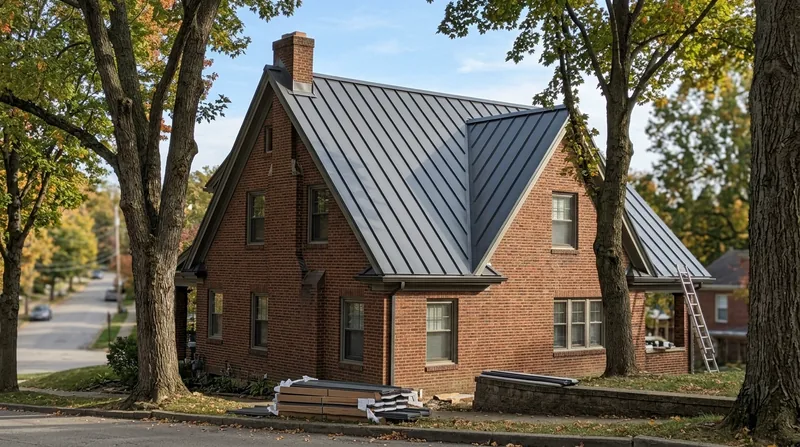




If you drive through Hyde Park or Mount Lookout, you can spot the roofs that have survived a hundred Cincinnati winters: steep gables, deep eaves, and a lot of them now wearing standing seam metal roofing in Cincinnati. The city sits on seven steep hills above the Ohio River, and that terrain changes everything about a roof. Narrow hillside lots in Mount Adams, deep ravines in Clifton, and clay soil over limestone and shale mean access is tight, water runs fast, and freeze-thaw cycling works at every seam and flashing from November through March. Standing seam handles that better than any exposed-fastener system because there is nothing to back out. We roll-form panels to length, seam them mechanically or snap-lock them, and leave the roof with no screws on the surface for ice and hail to attack. If you are weighing materials, start with our metal roof installation overview, then come back to this page for the standing seam specifics.
Why Standing Seam Makes Sense on Cincinnati's Hillside Homes
The housing stock here is hard on roofs. You have 1860s Italianate and Queen Anne brick rows in Over-the-Rhine and Northside, 1920s Tudor and Craftsman homes with steep gables in Clifton and Wyoming, post-war ranches in Westwood and Price Hill, and 1990s subdivision two-stories in Mason and Loveland. Sugar maples, tulip poplars, oaks, and sycamores drop limbs and leaves on all of them. Add severe thunderstorms with hail and straight-line wind, heavy wet snow, ice storms, and constant freeze-thaw, and the failure mode that dominates in this city is water working into seams and flashing during repeated thaw cycles.
- Concealed fasteners mean there are no screws to back out as the roof expands and contracts through freeze-thaw.
- Mechanically seamed panels resist uplift from straight-line wind and hail impact far better than exposed-fastener panels.
- The smooth finish sheds snow and leaves instead of trapping them behind ribs and fasteners.
- Panels roll-formed to length eliminate lap joints, which is where most hillside roof leaks begin.
- Long service life means one installation instead of two or three asphalt replacements over the same decades.
For steep-gable homes in Hyde Park and Mariemont, standing seam also keeps a clean profile that suits the architecture instead of fighting it.
Key info: On a 1920s Tudor in Clifton with a steep gable and two dormers, we rolled panels on site and seamed them in place because the narrow side lot would not take a delivery truck. That is standard practice on Cincinnati hillside streets, and it is why panel length planning matters before the first panel is cut.
Roofing permits are commonly required for a full replacement here, and thresholds, fees, and inspection requirements vary by jurisdiction. Always verify with the City of Cincinnati's buildings department before work starts: cincinnati-oh.gov/buildings.
How We Install Standing Seam on a Cincinnati Roof
Every standing seam job starts with the deck, not the panels. On older homes in Over-the-Rhine and Northside we often find skip sheathing or sagging boards under slate or tin, and those have to be corrected before a panel goes down. On 1980s and newer homes in Blue Ash and Anderson, the deck is usually sound, but ice-and-water membrane at the eaves and valleys still matters because of the freeze-thaw cycle. We plan panel lengths around the actual roof, not a stock size, and we seam every panel by hand or with a mechanical seamer depending on the profile.
- We inspect the deck, sheathing, and existing flashing, and we photograph anything that needs correction before we quote the work.
- We install underlayment and ice-and-water membrane at eaves, valleys, and around penetrations.
- We roll-form panels to the measured length on site or at the shop, depending on access.
- We set and fasten panels with concealed clips, then mechanically seam or snap-lock each rib.
- We fabricate and install flashing at chimneys, skylights, walls, and valleys, then test the roof with water before we clean up.
That sequence is why a standing seam roof on a Wyoming or Madeira home takes longer to plan than an asphalt tear-off, and why it lasts longer once it is done.
Key info: On a 1990s two-story in Loveland, the homeowner wanted panels over a porch addition that tied into the main roof. We ran the panel layout from the ridge down through the porch roof so the seams lined up, then flashed the transition. Misaligned seams at an addition are one of the most common things we correct on standing seam roofs.
If your roof ties into a chimney or skylight, our flashing, chimney and skylight repair page covers how we handle those transitions.
Standing Seam Profiles and Approaches We Use
Not every Cincinnati roof wants the same panel. A steep Queen Anne in Mount Adams, a low-slope porch roof in Oakley, and a long ranch run in Fairfield each call for a different approach. Here is how the main options compare on a local roof.
| Approach | Description | Best for |
|---|---|---|
| Mechanically seamed | Panels with raised ribs folded together by a mechanical seamer, creating a double-lock seam. | Steep gables and high-wind exposures on Hyde Park and Mount Lookout homes. |
| Snap-lock | Panels with a formed rib that snaps together without a mechanical seam. | Ranch and Cape Cod roofs in Westwood and Norwood where cost matters. |
| Roll-formed on site | Panels formed to exact length at the property to avoid lap joints. | Long runs and tight hillside lots in Mount Adams and Clifton. |
| Panel over existing deck | New panels installed over a sound, corrected deck after tear-off. | Full replacements on 1980s and newer homes in Mason and Blue Ash. |
| Standing seam retrofit | Panels installed over an existing roof system with proper underlayment and flashing. | Homeowners comparing against a full tear-off; see our metal roof over shingles page. |
We match the profile to the roof pitch, the exposure, and the architecture, not to whatever is on the truck.
Standing Seam Metal Roofing Cost in Cincinnati: What to Expect
Standing seam pricing starts at From $10/sq ft, and that figure is a starting point, not a quote. On a simple ranch roof in Fairfield or Sharonville, you may land near that number. On a steep, cut-up Tudor in Clifton with dormers, valleys, and a chimney, the panel count, seaming time, and flashing fabrication push the number up. Access is the other big variable: a narrow hillside lot in Mount Adams or a home behind a retaining wall in Price Hill can add labor for staging and material handling.
- Roof complexity drives cost more than square footage: valleys, dormers, and multiple roof planes mean more cuts and more seams.
- Panel profile and gauge affect material cost, with heavier gauge and mechanically seamed systems at the top of the range.
- Access and staging on steep hillside lots add labor that a flat suburban lot does not.
- Tear-off and deck repair on older homes in Over-the-Rhine and Northside can add scope once we open the roof.
- Color and finish choices matter for historic districts and HOAs, and some finishes carry a premium.
Get two or three estimates, ask what is included in each, and compare the deck work and flashing line by line, not just the total. Our pricing overview breaks down the ranges in more detail.
Standing Seam Metal Roofing Near Me: How to Vet a Contractor Around Cincinnati
Standing seam is a specialty system, and not every roofer who hangs shingles can seam a panel correctly. When you search for standing seam metal roofing near me around Cincinnati, look for a contractor who can show you standing seam work, not just metal roofs in general. Ask for the address of a recent job, and drive past it. Ask who rolls the panels and who seams them.
- Confirm the contractor is licensed and insured, and ask for a certificate of insurance before work starts.
- Get at least two or three written estimates that itemize deck work, underlayment, panels, flashing, and cleanup.
- Ask for references on standing seam jobs specifically, and call them.
- Ask who pulls the permit and confirm the scope matches what the jurisdiction requires.
- If you are in a historic district or an HOA, confirm panel profile and color are approved before you sign.
If a contractor cannot answer those questions clearly, keep looking. You can reach us through our contact page when you are ready to compare.
Standing Seam Metal Roofing in Cincinnati: Pricing Guide
| Service | Price | Details |
|---|---|---|
| Snap-lock standing seam | Starting at $10/sq ft | Includes panels, concealed clips, underlayment, and standard flashing on a simple roof with normal access. |
| Mechanically seamed standing seam | Starting at $13/sq ft | Includes on-site seaming, heavier gauge panels, and premium flashing for steep or high-wind exposures. |
| Complex roof with dormers and valleys | On estimate | Cut-up roof planes, multiple valleys, and chimney flashing need an on-site look before pricing. |
| Hillside or tight-access property | On estimate | Narrow lots and retaining walls in Mount Adams or Price Hill add staging and material handling labor. |
| Travel | Included | In Cincinnati and surrounding areas, no separate call-out or mileage fee. |
| Estimate | Free | Response within 24h at (513) 650-6986, no obligation to book. |
Indicative pricing, the exact cost depends on square footage, finish, and site access. Free personalized estimate within 24h at (513) 650-6986.


