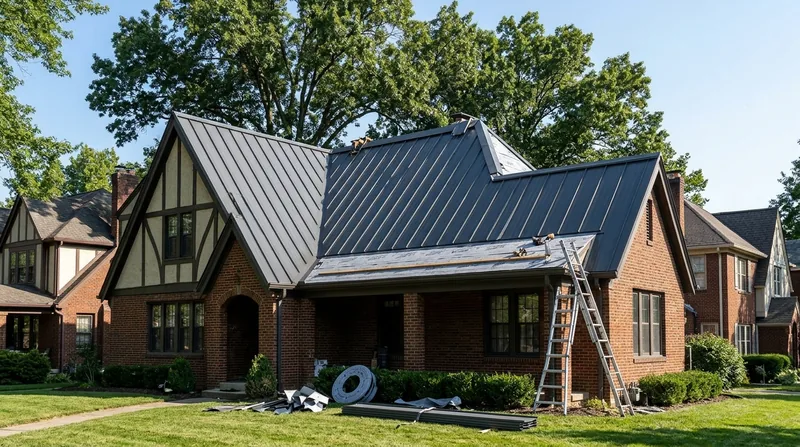




Metal Roof Installation in Cincinnati: Built for Seven Hills and Ohio River Weather
When you need Metal Roof Installation in Cincinnati, the roof has to handle more than most homeowners realize. This city sits on seven steep hills above the Ohio River, and the housing stock runs from 1860s Italianate and Queen Anne brick rows in Over-the-Rhine and Mount Adams to Tudor and Craftsman homes in Hyde Park and Clifton, post-war ranches in Westwood and Price Hill, and 1990s subdivision homes in Mason and Loveland. Clay soil over limestone and shale shifts under narrow hillside lots with retaining walls and deep ravines. Sugar maples, tulip poplars, oaks and sycamores drop limbs and leaves on roofs every season. Add humid summers, hail-bearing thunderstorms, ice storms and constant freeze-thaw cycling, and you get a climate that punishes seams and flashing. We install panel systems engineered for exactly this: over ice-and-water membrane, synthetic underlayment and proper ventilation, with clean flashing details for a 40 to 60 year service life. If you are also weighing a standing seam metal roof, that system pairs well with the same installation approach.
Why Metal Roof Installation Matters on Cincinnati's Hills and Older Streets
Most roof failures in this city trace back to water working into flashing, seams and penetrations during freeze-thaw cycles, not to the panel field itself. Older homes in Hyde Park, Mount Lookout and Wyoming often carry steep gables, clay tile or slate, and chimneys or skylights that were never flashed for a metal system. Hillside lots in Mount Adams and Northside funnel wind and runoff in ways flat-lot subdivisions in Blue Ash and Mason never see. A properly installed metal roof addresses all of it at once.
- We install over ice-and-water membrane at eaves, valleys and penetrations, which matters when ice dams form after heavy wet snow.
- We size ventilation to the attic volume so humid summer air does not condense on the underside of panels.
- We fasten to manufacturer specification for wind uplift, which matters on exposed ridge lines and hillside gables.
- We detail flashing at chimneys, skylights and sidewalls so freeze-thaw cycling does not open a path for water.
- We choose panel profiles and colors that clear historic district and HOA design review where it applies.
That combination is what separates a roof that lasts decades from one that leaks within a few winters.
Key info: A homeowner in Mount Lookout with a 1920s Tudor had a slate roof patched three times in eight years. The ice-and-water membrane under the old flashing had failed, and meltwater was running behind the chimney. A full metal installation with new flashing and a proper underlayment stopped the leak for good.
Roofing permits are commonly required for a full replacement or re-roof in Cincinnati and Hamilton County, and thresholds, fees and inspection requirements vary by jurisdiction. Confirm the current rules with the City of Cincinnati Buildings and Inspections Department before work begins.
How We Install a Metal Roof on a Cincinnati Home
Every installation starts with a full tear-off and deck inspection, because we need to see what the old roof hid. On a 1900s Craftsman in Norwood, that might mean replacing rotted sheathing around a chimney. On a 1990s two-story in Anderson, it usually means confirming the deck is flat and dry. From there, the sequence is the same on every job.
- We strip the old roofing and inspect the deck for rot, soft spots and failed fasteners.
- We install ice-and-water membrane at eaves, valleys and penetrations, then synthetic underlayment across the field.
- We set new flashing at chimneys, skylights and sidewalls, and we verify attic ventilation before closing anything up.
- We install the panels to manufacturer specification for clip spacing, fastener torque and panel alignment.
- We walk the roof, check every seam and penetration, and clean the gutters before we leave.
That sequence is what lets us stand behind the installation for decades.
Key info: On a steep gable in Mariemont, the old chimney flashing had been tarred over twice. We rebuilt the counterflashing and installed a new cricket, which is the detail that keeps water from pooling behind the chimney during a thaw. The homeowner had not realized the leak source was the flashing, not the shingles.
For homes in the 45202 and 45212 ZIP codes, see our local pages for Cincinnati 45202 and Norwood 45212.
Installation Approaches We Use Across Cincinnati
The right system depends on the pitch, the neighborhood, the budget and the look you want. Here is how the main approaches compare for Cincinnati homes.
| Approach | Description | Best for |
|---|---|---|
| Standing seam | Concealed fasteners, raised seams, clean vertical lines | Homeowners who want maximum weather protection and a modern look |
| Exposed fastener panels | Corrugated or ribbed panels with visible screws | Porches, additions and budget-conscious whole-house roofs |
| Metal shingles | Stamped panels that mimic slate or tile | Historic homes in Hyde Park and Clifton with design review |
| Stone-coated steel | Textured steel panels with a granular finish | Homeowners who want the look of shingles with metal durability |
| Copper and specialty metal | Copper, zinc and similar metals with soldered or seamed details | Landmark homes and architectural accents |
We match the system to the house, not the other way around.
Metal Roof Installation Cost in Cincinnati: What to Expect
Most full installations in this market start around $8 per square foot for the installed system, and the final number depends on the panel type, roof pitch, number of penetrations and how much deck repair the tear-off reveals. A simple ranch in Westwood costs less than a steep-gabled Tudor in Hyde Park with multiple chimneys and dormers. Hillside lots in Mount Adams can add access costs, and historic district or HOA review can add design and paperwork time.
Getting two or three written estimates is the smart move. It gives you a real comparison on panel gauge, underlayment, flashing details and warranty terms, not just a number. For a detailed breakdown by system and roof size, see our metal roofing pricing page.
Hiring a Metal Roofing Contractor Near Me in Cincinnati: What to Check
You want a contractor who can show you the details, not just quote a price. Ask how they handle ice-and-water membrane, ventilation and flashing, because those are the parts that fail first in this climate. Verify licensing and insurance, and ask for the certificate of insurance directly. Check references for jobs similar to yours, especially older homes with steep gables or historic district requirements.
Understand the permit process before work starts, and confirm who pulls the permit and who handles inspection. If your home sits in a historic district or an HOA, get the design review approval in writing before panels are ordered. A contractor who walks you through all of that is the one you want.
Ready to talk through your roof? Contact us for a free estimate at (513) 650-6986.
Metal Roof Installation in Cincinnati: Pricing Guide
| Service | Price | Details |
|---|---|---|
| Standing seam installation | Starting at $8/sq ft | Includes tear-off, underlayment, flashing and concealed-fastener panels; pitch and panel gauge move the rate |
| Exposed fastener panel installation | Starting at $6/sq ft | Corrugated or ribbed panels with visible screws; roof size and number of penetrations affect the price |
| Metal shingle or stone-coated steel installation | Starting at $9/sq ft | Stamped or textured panels with full underlayment; historic district review can add design time |
| Complex or large-scale installation | On estimate | Steep gables, multiple chimneys, dormers or deck repair need an on-site look before pricing |
| Travel | Included | In Cincinnati and surrounding areas, no separate call-out or mileage fee |
| Estimate | Free | Response within 24h at (513) 650-6986, no obligation to book |
Indicative pricing, the exact cost depends on square footage, finish, and site access. Free personalized estimate within 24h at (513) 650-6986.


